SN1 & SN2 Substitution Reactions
Master nucleophilic substitution — mechanism, stereochemistry, and how to predict SN1 vs. SN2 with confidence, with a dedicated one-on-one Ochem tutor.
Part of our complete Ochem Tutor program, alongside our full mechanisms tutoring.
Book Your Trial ClassWhat We Cover
Complete Guide: Alkyl Halides, SN1 & SN2 Mechanisms
A full walkthrough of nucleophilic substitution — from why C–X bonds are polar, through every factor that decides SN1 vs. SN2, to how elimination competes with substitution.
Alkyl Halides
The alkyl halides are polar compounds due to the characteristic feature of the C–X bond. As we know, halogens are more electronegative than carbon. As a result, the electron density is highly shifted towards the halogen, giving a partial negative charge (δ−) to the halogen and the carbon becomes partially positive (δ+).
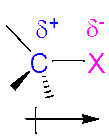
The halogen-connected carbon acts as an electrophile and may be attacked by an electron-rich species called a nucleophile. In this process, the halogen is replaced (substituted) by the nucleophile — this is called a nucleophilic substitution reaction.

SN2: Bimolecular Nucleophilic Substitution
The above reaction order of kinetics is second order. It is justified by the following reasons:
- The two reactants (alkyl halide & nucleophile) interact with each other in a single step.
- The rate of reaction depends on the initial concentrations of both the alkyl halide and the nucleophile.
For example, the rate of reaction doubles when doubling the concentration of either the nucleophile or the alkyl halide. Doubling the concentrations of both increases the rate by a factor of 4. These results are consistent with a second-order process, explained by the following equation:
![Ochem Tutor SN2 rate equation: Rate = k[alkyl halide][Nucleophile]](/images/sn-mechanisms/ochem-tutor-sn2-rate-equation.gif)
The reaction is therefore called bimolecular nucleophilic substitution, abbreviated as SN2 (S stands for substitution, N for nucleophilic, and 2 for bimolecular).
Mechanism for SN2 Reaction
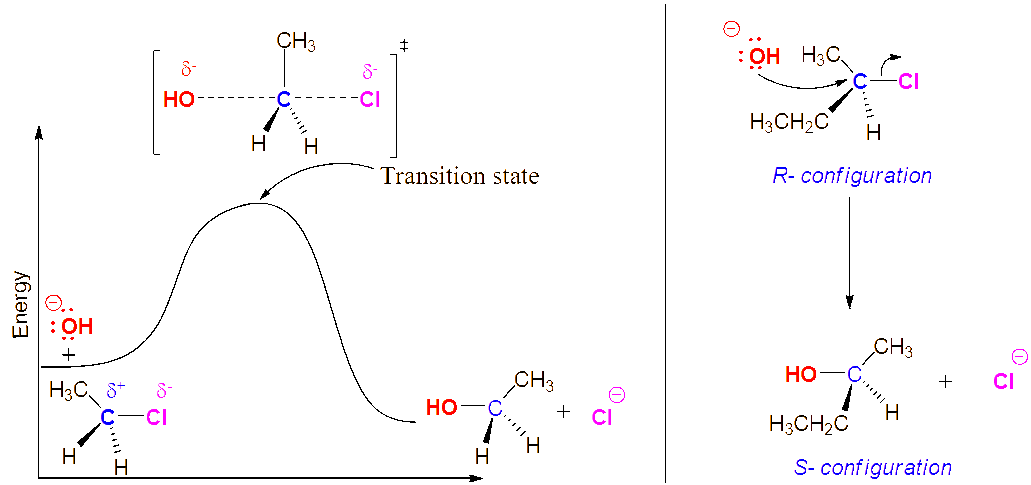
- The nucleophile attacks the back side of the carbon that is bonded to the leaving group.
- SN2 is a concerted process — the nucleophilic attack and loss of the leaving group occur simultaneously (a single step).
- The transition state is not a separate step; it describes the geometric arrangement of the reacting species at the point of maximum potential energy.
- Due to backside attack, SN2 always gives inversion of configuration, so it is called a stereospecific reaction.
Factors Affecting the SN2 Reaction
1. Bulkiness of the alkyl group
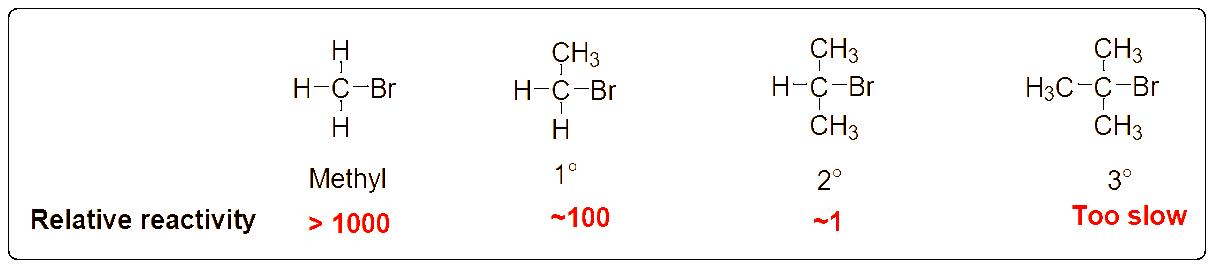
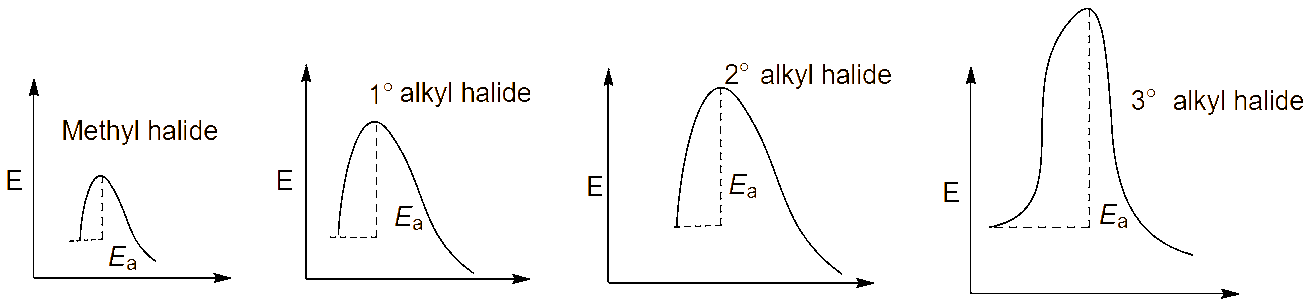
The nucleophile experiences steric hindrance when it approaches a halogen-connected carbon that is highly substituted. The reason tertiary alkyl halides react too slowly in SN2 is that they have the highest transition state energy compared to secondary and primary. Increasing steric hindrance increases the transition state energy:
Substitution at the β-position also causes steric hindrance and decreases the rate of reaction:
2. Nature of the leaving group
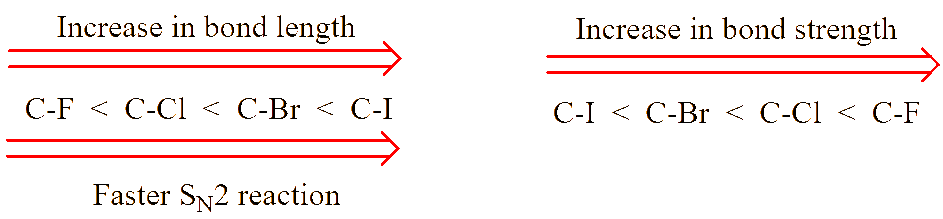
A faster SN2 reaction depends on a good leaving group, which comes down to two factors:
- C–X bond strength (applicable only for halogens)
- Stability of the leaving group (the prime factor)

The C–X bond forms from the overlap of a carbon sp3 hybrid orbital and a halogen p orbital. Atomic size increases moving down the periodic table, causing a size mismatch that leads to poorer orbital overlap — and therefore longer, weaker C–X bonds. In short: short bonds are stronger than long bonds.
Weak bases are generally good leaving groups because they can easily stabilize the negative charge. Besides halogens, alkyl sulfates and sulfonates are good leaving groups — they are weak bases whose negative charge is stabilized by resonance.
3. Nature of the nucleophile
Nucleophilicity depends on charge, electronegativity, and bulkiness.
- Charge — a negatively charged nucleophile is strong; a neutral one is weak.
- Electronegativity — nucleophilicity decreases moving left to right across a period, and increases moving down a group. Halide ion nucleophilicity follows I > Br > Cl > F (though this depends on the solvent). This is why sulfur nucleophiles are more powerful than their oxygen analogues — the same logic applies to phosphorus versus nitrogen.
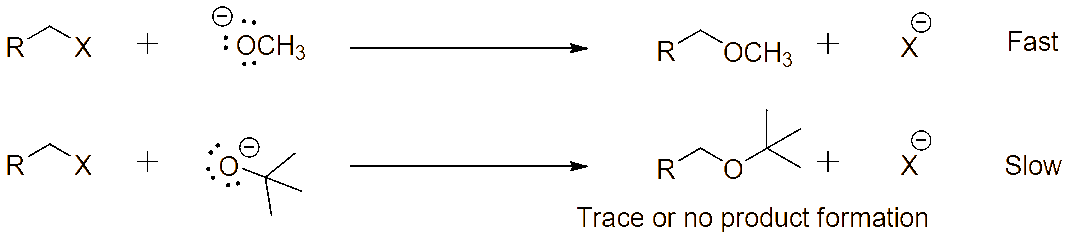
- Bulkiness — bulkier nucleophiles react slowly and behave more like a base than a nucleophile, favoring elimination over substitution.

Chemically, a base and a nucleophile are the same species — they're distinguished only by their mode of action. Attacking a proton makes it a base; attacking any other nucleus (e.g. carbon) makes it a nucleophile. Basicity is thermodynamically controlled; nucleophilicity is kinetically controlled.
4. Nature of the solvent
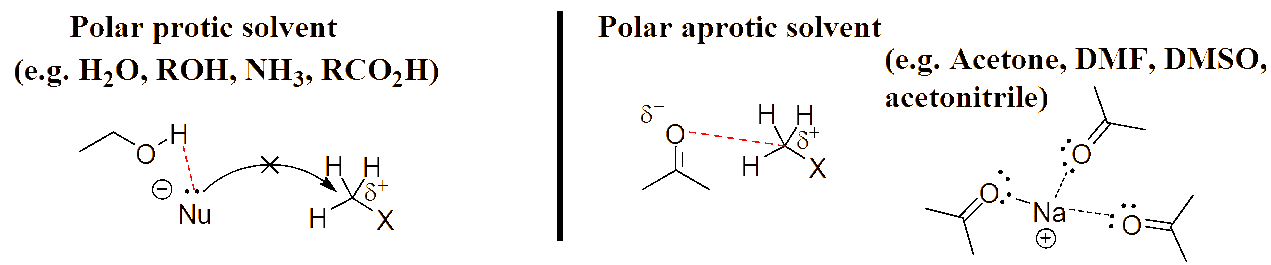
Polar solvents are preferred for SN2 since alkyl halides are polar. Polar protic solvents are less favorable — they solvate the smaller, negatively charged nucleophile by hydrogen bonding, slowing the reaction. Polar aprotic solvents solvate the electrophilic carbon and the positive counter-ion without hydrogen-bonding the nucleophile, so they are highly preferred forSN2.

In a polar protic solvent, halide nucleophilicity follows I > Br > Cl > F; this order reverses in a polar aprotic solvent.
Ambident nucleophiles
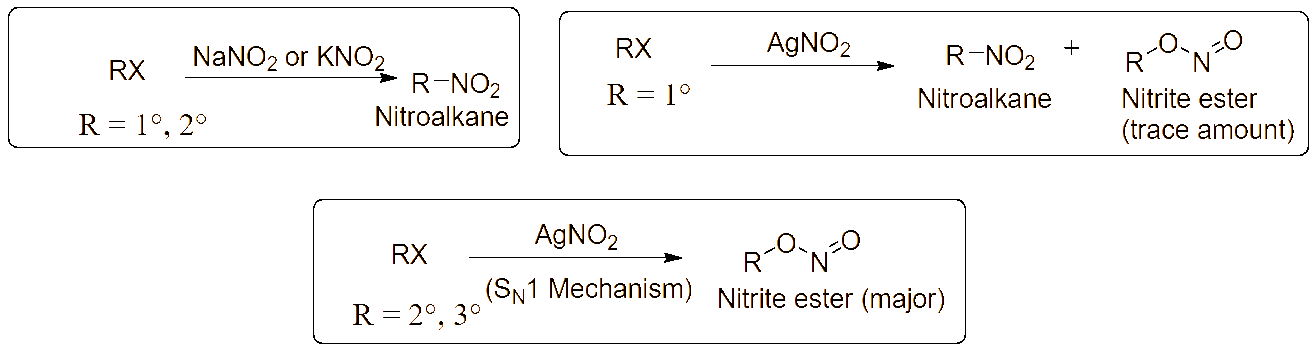
An ambident nucleophile has two reactive centers where negative charge is delocalized over two different atoms through resonance. For example: cyano (nitrile) derivatives are prepared using NaCN or KCN, while isocyanide (isonitrile) is achieved using AgCN. Sodium or potassium nitrite can be used to prepare nitro compounds from primary or secondary alkyl bromides or iodides, though the method has limited scope. Silver nitrite gives nitro compounds only when the alkyl halide is a primary bromide or iodide — nitrite esters are an important side product in all these cases, and become the major product (via an SN1 mechanism) when secondary or tertiary halides are treated with silver nitrite. The use of Ag+ promotes attack by the strongly electronegative atom.

SN1: Unimolecular Nucleophilic Substitution
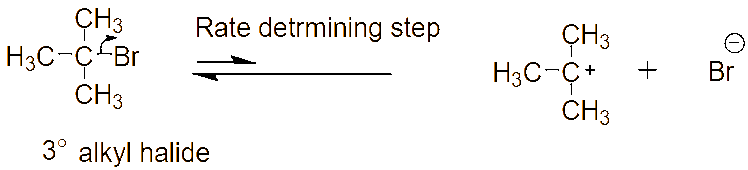
As shown above, tertiary alkyl halides cannot undergo SN2 due to steric bulk. Is there any way for a tertiary alkyl halide to still undergo substitution? Yes — through a stepwise mechanism rather than the concerted SN2 pathway.
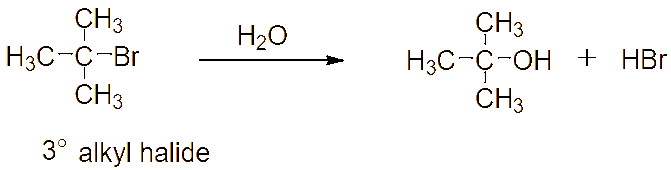
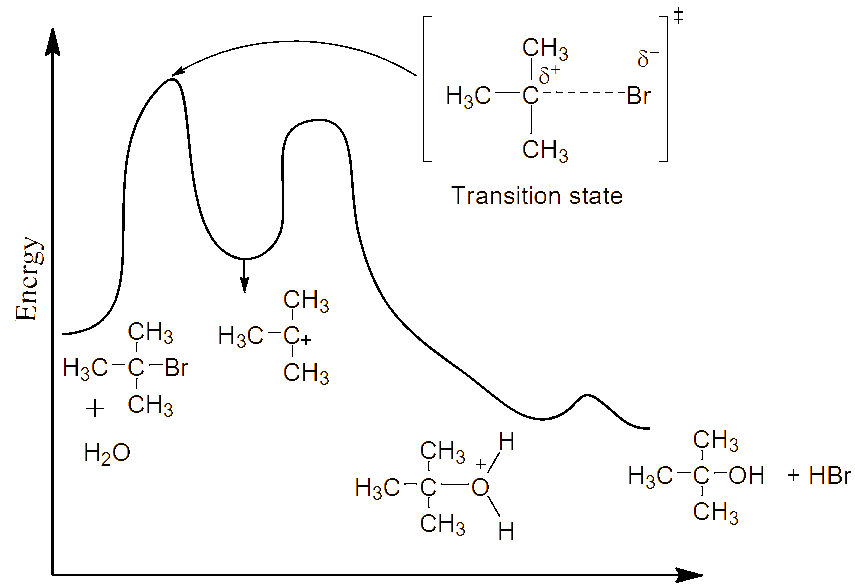
A carbocation forms first, and the nucleophile attacks it in a second step to form the substitution product. The nucleophile here may be weaker, or may simply be the solvent itself — if the nucleophile is the solvent, this is called a solvolysis reaction.


The overall reaction is depicted as:
The above reaction order of kinetics is first order, because:
- Only one reactant (the alkyl halide) is involved in the rate-determining step.
- The rate of reaction depends on the formation of a stable carbocation from the alkyl halide.
![Ochem Tutor SN1 rate equation: Rate = k[alkyl halide]](/images/sn-mechanisms/ochem-tutor-sn1-rate-equation.gif)
The reaction is called unimolecular nucleophilic substitution, abbreviated SN1 (S for substitution, N for nucleophilic, 1 for unimolecular).
Factors Affecting the SN1 Reaction
1. Nature of the alkyl group
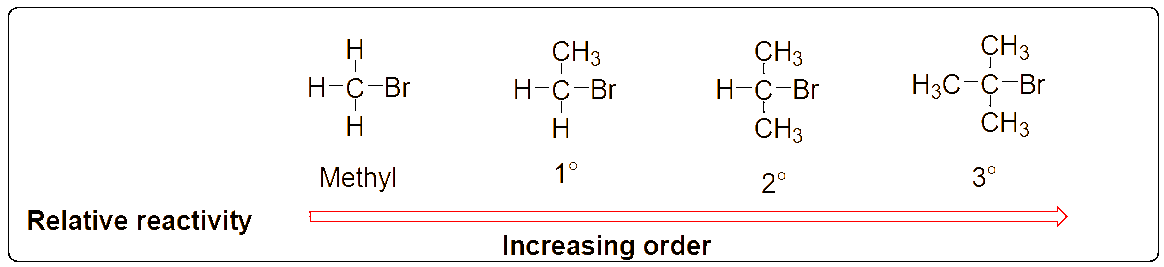
Carbocation formation is governed by hyperconjugation; stability order is 3° > 2° > 1° > CH3. A tertiary carbocation has a smaller activation energy than secondary or primary carbocations, so it forms faster.
Secondary alkyl halides can go either SN1 or SN2, depending on conditions: SN1 is favored with a very good leaving group, a weak nucleophile, and a polar protic solvent. SN2 is favored with a reasonable leaving group, a good nucleophile, and a polar aprotic solvent.

2. Nature of the leaving group
Both SN1 and SN2 need a good leaving group, but it matters more for SN1 — the rate of leaving-group departure determines carbocation formation, the rate-determining step.
3. Nature of the nucleophile
Unlike SN2, the rate of SN1 is not affected by nucleophile concentration or strength, since the nucleophile doesn't participate in the rate-determining step — though it does affect product distribution when multiple nucleophiles compete. A weaker nucleophile favors SN1.
4. Nature of the solvent
SN1 reactions are favored by polar protic solvents, which stabilize the polar intermediates and transition states.
Energy diagram for the SN1 reaction
Stereochemical outcome
SN1 on a chiral compound gives a racemic mixture, while SN2 gives inversion of configuration.
SN1 vs. SN2 at a Glance
| SN1 | SN2 |
|---|---|
| Rate depends only on alkyl halide concentration | Rate depends on both alkyl halide & nucleophile concentration |
| Proceeds through carbocation formation and its stability | Steric hindrance is the key factor affecting rate |
| R–X reactivity: 3° > 2° > 1° > CH3 | R–X reactivity: CH3 > 1° > 2° > 3° |
| Weak or neutral nucleophile (e.g. H2O, ROH) | Strong, generally negatively charged nucleophile (e.g. –OH, CH3O–) |
| Requires polar protic solvent (e.g. H2O, ROH) | Requires polar aprotic solvent (e.g. acetone, DMF) |
| Gives racemic mixture on a chiral center | Gives inversion of configuration on a chiral center |
Common Struggles With Substitution Reactions
“I can never tell if a reaction is SN1 or SN2.”
We use a clear decision framework — substrate type, nucleophile strength, and solvent — so choosing the right mechanism becomes systematic rather than a guess.
“I don't understand why SN2 inverts stereochemistry.”
We walk through the backside-attack geometry step by step with models, so the inversion becomes visually obvious rather than a fact to memorize.
“Carbocation stability rules confuse me.”
We build the stability ranking (3° > 2° > 1°) from first principles — hyperconjugation and inductive effects — so it holds up on any exam question, not just textbook examples.
Meet Your Tutor
Dr. R Ramajayam
Organic Chemistry Tutor
Frequently Asked Questions
SN2 is a single-step, concerted reaction with backside attack that inverts stereochemistry and favors less hindered substrates. SN1 is a two-step reaction through a carbocation intermediate, favoring more substituted (more stable) substrates and often giving a mix of stereochemical outcomes.
Ready to Master Substitution Reactions?
Book a trial class and get SN1/SN2 to click with clear, step-by-step reasoning.
Book Your Trial Class